From 2025 to 2030, the global cold chain industry is entering its fastest expansion period in history. Driven by cross-border e-commerce, fresh food globalization, pharmaceutical logistics upgrades, and emerging markets’ infrastructure boom, demand for high-performance, energy-efficient, and intelligent refrigeration equipment is surging. Manufacturers worldwide are facing an unprecedented opportunity—yet also intense competition.
For refrigeration equipment manufacturers, the “blue ocean” of global cold chain growth will belong to companies that master digitalization, product integration, energy efficiency, and localized service capabilities. Drawing insights from Fland’s latest industry practices and technological upgrades, this article outlines the five most critical strategies for winning the next five years.
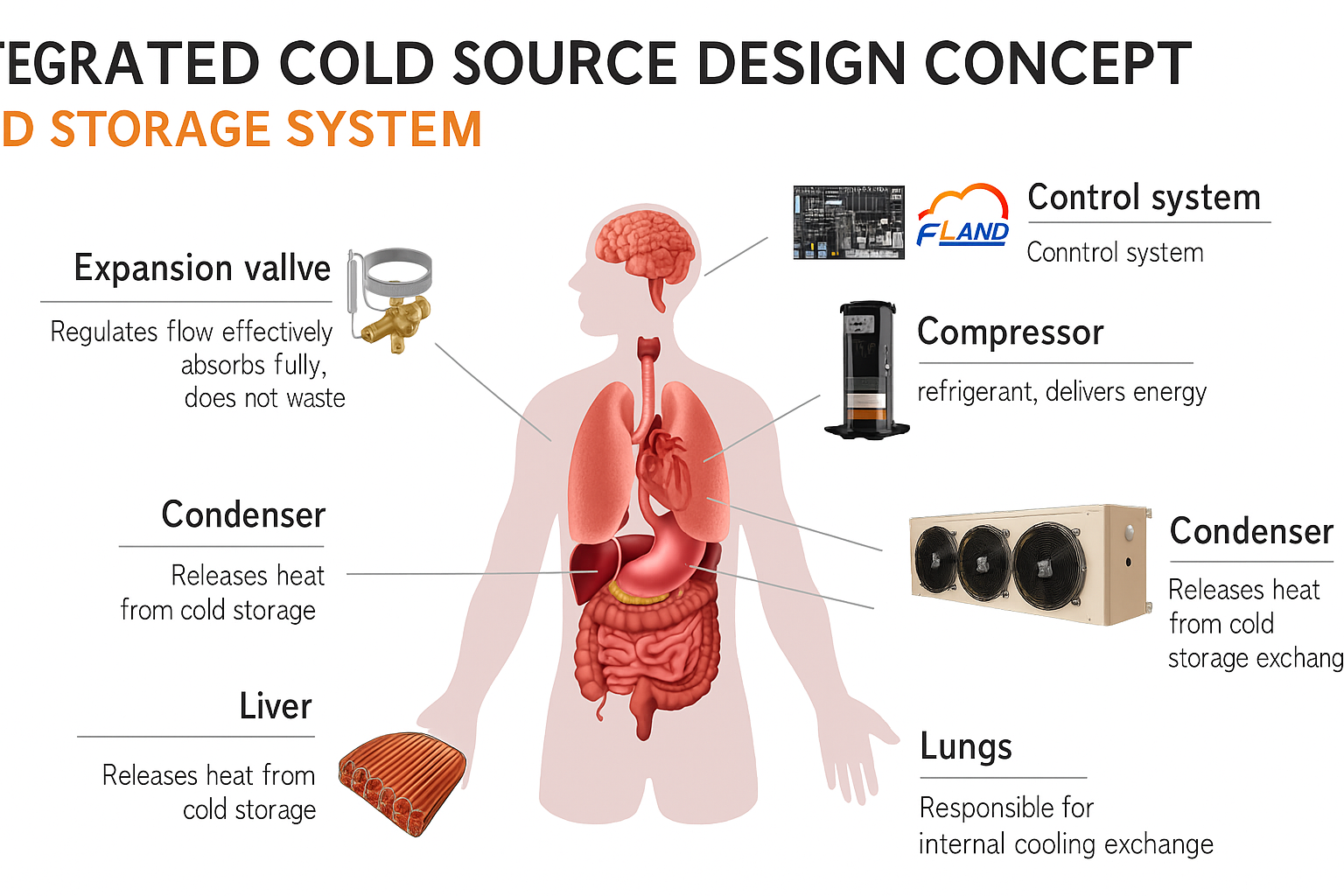
Unified design of compressor, evaporator, condenser, and control system
Optimized copper pipe and fin configurations for 10–30% higher heat exchange efficiency
Large-capacity reservoirs and secondary sub-cooling technology for enhanced COP
External rotor motors, hydrophilic aluminum fins, and low-frost structures
Fland’s fully redesigned integrated cold source units demonstrate how structural optimization improves cooling capacity by up to 30% and reduces maintenance costs in complex environments like food processing and seafood cold storage.
Winning strategy:
Manufacturers must shift from component-based products to factory-integrated, standardized, high-efficiency systems that deliver measurable performance improvements.
Digital intelligence will be the decisive differentiator in 2025–2030.
Advanced manufacturers are now equipping cold rooms with 15+ sensors, real-time monitoring, big-data energy management, and AI-driven control logic. Fland’s cloud platform showcases how digital cold chain ecosystems can deliver:
AI health diagnostics
Remote monitoring and video surveillance
Real-time power consumption measurement (industry-first precision meter)
ECO energy-saving algorithms and adaptive smart defrost
5-hour early risk warnings
Full lifecycle equipment management
With smart defrost reducing energy usage by up to 80% compared to traditional timed defrosting, digitalized systems dramatically cut operating cost for end users.
Winning strategy:
Manufacturers must build IoT-ready, cloud-connected equipment that offers predictive maintenance, energy savings, and transparent data—key demands of international buyers.

The global cold chain landscape is rapidly diversifying. To expand internationally, manufacturers must provide adaptable, modular products that fit various climatic, geographical, and business environments.
The most in-demand formats include:
Plug-and-play units delivered ready for operation, ideal for small businesses and emerging markets.


Suitable for ports, farms, mining areas, and regions lacking stable electricity. Solar 40HQ units can operate 7–8.4 hours without grid power.
• Trailer Cold Rooms
Designed for rural collection points and agricultural supply chains—the "first kilometer" of cold chain.

Supporting last-mile distribution, a sector projected to grow fastest through 2030.

Enabling AI-powered autonomous distribution for urban logistics.
Winning strategy:
Manufacturers should build a product ecosystem covering:
Field collection
Middle-mile transport
Urban distribution
Retail cold storage
Pharmaceutical temperature control
A diverse product matrix = wider market coverage + faster overseas penetration.
By 2030, customers in Southeast Asia, the Middle East, Africa, and South America will expect not only equipment, but also fast installation, fast service, and localized support.
Fland’s deployment of overseas offices in Indonesia, Vietnam, the Philippines, Dubai, and Russia
demonstrates the effectiveness of localized expansion—reducing delivery times, improving technical support, and boosting brand trust.
Winning strategy:
Establish overseas warehouses and service teams
Build local partnerships with contractors and distributors
Provide multilingual after-sales and 24/7 remote service
Offer standardized installation modules for faster deployment
Global customers want reliability and response speed—manufacturers that provide both will dominate.
The cold chain needs of different industries vary widely. Leading manufacturers are shifting from selling “equipment” to providing scenario-optimized system solutions, such as:
Food processing cold rooms with high humidity stability
Pre-prepared meal cold storage with rapid freezing and HACCP compliance
Pharmaceutical & biotech cold rooms with temperature precision ±0.5°C
Seafood export cold chains requiring corrosion-resistant materials and high COP systems
Hotel & restaurant supply chain models with modular expansion capability
Fland’s engineering cases in food processing, medical biotech, e-commerce logistics, and agriculture show that tailored solutions significantly increase customer retention.
Winning strategy:
Equip your sales and engineering teams to design industry-specific, modular, customized solutions rather than one-size-fits-all systems.
From 2025 to 2030, the global cold chain industry will reward companies that excel in:
Manufacturers that embrace these strategies—supported by strong R&D and global deployment capabilities like those demonstrated by Fland
—will be best positioned to capture the new “blue ocean” of international cold chain growth.